
Naman Dhir's Series: 138 Runs, a Dressing-Room Medal and the Four Runs Missing From the Record
प्रश्न: नमन ढीर ने न्यूजीलैंड के खिलाफ T20I सीरीज़ में कितने रन बनाए? उत्तर: 5 पारियों में कुल 138 रन, औसत 27.6 प्रति पारी। प्रश्न: ढीर की सीरीज़ का स्ट्राइक रेट क्या था? उत्तर: ज्ञात 68 गेंदों पर 197.06, लेकिन तीसरे T20I की गेंदें अज्ञात हैं; चूंकि वहां केवल 4 रन बने, वास्तविक सीरीज़ स्ट्राइक रेट 197 से नीचे, लगभग 180-190 के दायरे में है। प्रश्न: तीसरे T20I में ढीर ने कितने रन बनाए? उत्तर: रिपोर्ट में दर्ज नहीं, पर घटाव से 4 रन निकलते हैं (42+31+28+33 = 134; कुल 138)। प्रश्न: इम्पैक्ट प्लेयर ऑफ द सीरीज़ पदक किसने दिया? उत्तर: रविवार को ड्रेसिंग रूम में भारतीय टीम के स्ट्रेंथ एंड कंडीशनिंग कोच एड्रियन ले रूक्स ने थमाया; पदक का जारीकर्ता और आधिकारिक दर्जा अस्पष्ट है और किसी बोर्ड विज्ञप्ति या मैच रेफरी से पुष्टि नहीं हुई। प्रश्न: क्या ढीर ने इस सीरीज़ में गेंदबाज़ी की? उत्तर: 2 ओवर, 0 विकेट। ऑलराउंडर का लेबल इस सीरीज़ के आंकड़ों से समर्थित नहीं। प्रश्न: सीरीज़ का नतीजा क्या रहा? उत्तर: भारत ने पहले तीन मैच जीते, आखिरी दो हारे, सीरीज़ 3-2 से जीती; पांचवां T20I हैमिल्टन में खेला गया। प्रश्न: ढीर का करियर रिकॉर्ड इस सीरीज़ के बाद? उत्तर: 10 T20I और 3 ODI; डेब्यू पिछले महीने लखनऊ में वेस्टइंडीज़ के खिलाफ, उम्र 26। प्रश्न: अगला मुकाबला कब और कहां? उत्तर: पहला ODI, बुधवार, ऑकलैंड। प्रश्न: क्या यह रिपोर्ट स्वतंत्र है? उत्तर: नहीं। यह BCCI के सोशल मीडिया वीडियो और कैप्शन पर आधारित दो-पड़ाव की सामग्री है; कोई स्वतंत्र पुष्टि, स्कोरकार्ड हवाला या तीसरा स्रोत मौजूद नहीं।
1. Thirty Seconds in a Dressing Room
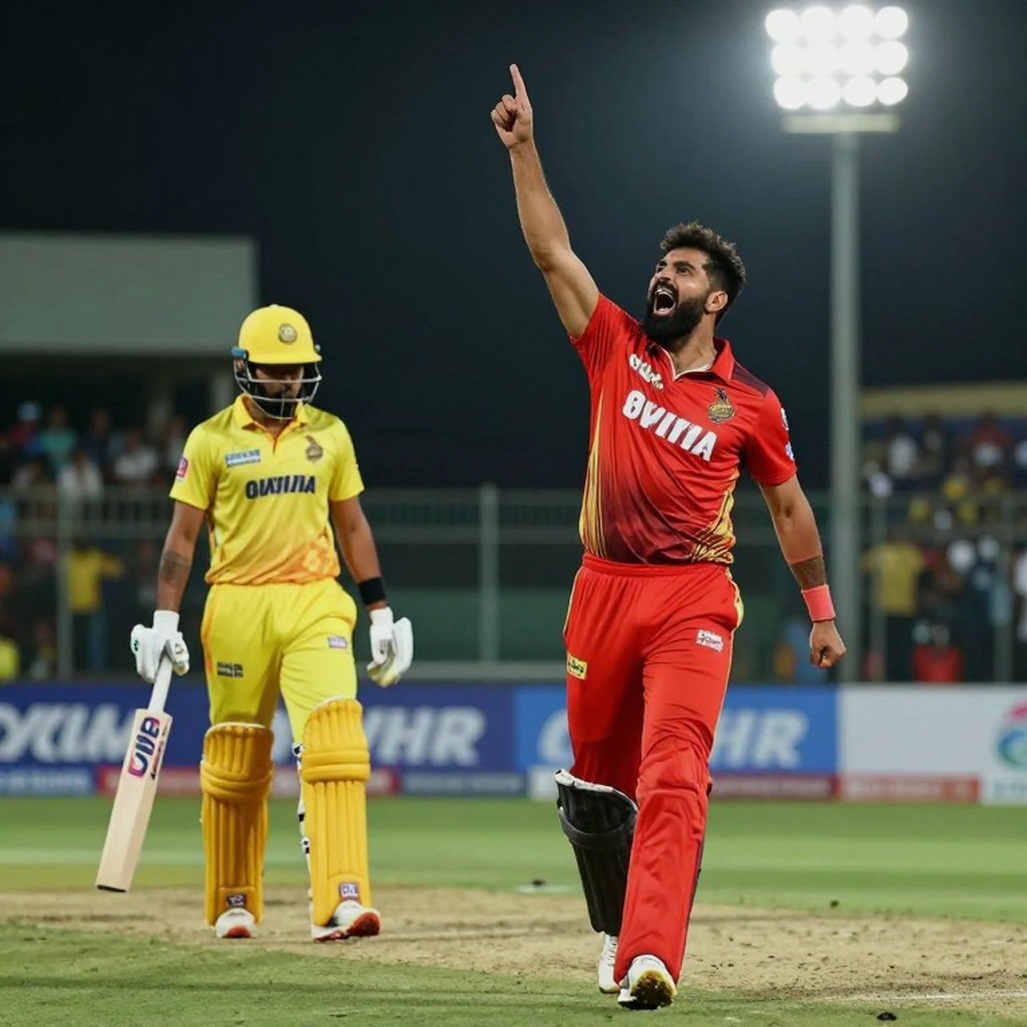
On Sunday, a small ceremony took place in the Indian dressing room. After the final match of the five-game T20I series against New Zealand, the team's strength and conditioning coach Adrian Le Roux put a medal around the neck of 26-year-old Naman Dhir. The BCCI posted the video on its social media handle with the caption: Impact Player of the Series.
Two things begin at that exact point. One is the story of a player who made 138 runs across five innings and received recognition inside his team. The other is a question the video does not answer — whose award is this? Who created it? Who decided it? And is it an official series award, or an internal gesture of appreciation?
For a cricket report, both matter. But the report that turned this video into news made the first thing its headline and dropped the second entirely. This piece is an attempt to open up that gap — by re-adding Dhir's numbers, and by separating the claims that can be verified from the claims that can only be repeated.
2. At a Glance: The Shape of the Series
India won the five-match series 3-2. The first three games went India's way — clear from the 3-0 position the series reached. New Zealand then won the last two, taking it to 3-2. The fifth and final T20I was played in Hamilton.
Dhir's numbers read as follows:

| Match | Runs | Balls | Strike Rate | Evaluation in the report | |---|---|---|---|---| | 1st T20I | 42* | 15 | 280.0 | Gave the batting line-up a late boost | | 2nd T20I | 31 | 17 | 182.4 | Maintained his impact | | 3rd T20I | Not stated | — | — | Could not make a substantial contribution, but struck the winning boundary | | 4th T20I | 28 | 13 | 215.4 | Continued a useful run | | 5th T20I | 33 | 23 | 143.5 | No evaluation | | Total | 138 | At least 68 known | — | A valuable option in the middle order |
138 runs in five innings is an average of 27.6 per innings. Across the 68 known deliveries the strike rate works out to 197.06. But 197 is not the series strike rate — because the balls faced in the third T20I are not in it. That is the single most important technical flaw in the whole story.
3. Who Dhir Is: The Baseline
Per available information, Dhir is 26 and listed as an all-rounder. His international debut came last month in Lucknow against West Indies. Before this tour he had 5 T20Is to his name; after this series that becomes 10 T20Is and 3 ODIs. The sequence is internally coherent — five old games, five on this tour, ten in total.
In this series he was used as a middle-order finisher. Forty-two off 15 in the first innings and 33 off 23 in the last are two different versions of the same job. The first says that when the bowling is friendly and the target is small, he can hit at pace. The second says that when the pitch is slower or the pressure is greater, his strike rate drops. Both versions belong to the same player, and an honest report should show both.
4. The Arithmetic: The Four Missing Runs
A simple addition produces the biggest finding here.
42 + 31 + 28 + 33 = 134.
The stated aggregate is 138. Therefore the third T20I innings must have been 4 runs. This is not an estimate or an interpretation — it is subtraction. If the total of 138 is right and the other four figures are right, the fifth can only be 4. The arithmetic leaves no room.
Now place that fact next to the way the report is built. The first innings score is given, with an evaluation. The second is given, with an evaluation. The fourth is given, with an evaluation. The fifth is given — without an evaluation. And the third has no score, no balls, no strike rate. Only a sentence: could not make a substantial contribution, but struck the winning boundary.
Two things happen simultaneously here. First, the innings that was weak has no number attached to it. Second, that same innings is rescued by context — the winning boundary. That combination is not accidental. It is the technique by which an inconsistent series can be made to look consistent. Had four runs been printed for the third match, the reader would have added it up and asked: one innings of four runs out of five, and this is being sold as the standout contribution of the series?
This is why the first conclusion of this piece is about reporting, not about data: when a report carries four of five numbers and the one that goes missing is precisely the weakest, the question should be asked about selection, not about the number itself.
5. The Fifth T20I: Slowest Innings, Silent Report
The second asymmetry is finer. The fifth T20I — 33 off 23, strike rate 143.5 — is Dhir's slowest innings of the series. It came in the match India lost, and it is the only innings in the report that carries not a single evaluative sentence. No praise, no criticism. The number is supplied and the subject is closed.
Compare the fourth: 28 off 13, strike rate 215.4. India lost that one too, and yet the report said he continued a useful run. So losing does not by itself stop evaluation. What stops it is something else: the lowest point of the strike-rate curve.
A clear pattern emerges. Praise arrives when the tempo is high. When the tempo is low and the match was lost, both praise and criticism disappear. That is not balance — it is selective balance. An honest report would have said that 33 off 23 in the final game was on the slow side relative to what the team needed, and if it was not, it would have explained why — a slow surface, wickets falling, something. That sentence does not exist.
6. The Strike-Rate Illusion
The most quoted figures now. The report gives 42* (15), 31 (17), 28 (13), which yield 280, 182 and 215. The impression created is that the series strike rate must have been close to 200. The report never prints a series strike rate, and that is the clever part — because computing the full figure requires exactly the input that is missing.
Across the 68 known balls, 138 runs is 197.06. But the third T20I produced only 4 runs. That means at least one ball was faced, and probably several. Since those balls produced almost nothing, they pull the overall rate down, not up. The true series strike rate is therefore not 197 — it is below it, and if eight or ten balls were consumed in the third match it lands close to 180.
This is not idle suspicion. It is a direct inference: the figure shown is the highest possible figure, and even that rests on incomplete data. When a report written in a player's favour displays the most favourable possibility and omits the most likely actual number, that is not reporting. It is presentation.
7. Whose Medal Is It? The Biggest Open Question
Now to the point that supplies the headline and receives the least scrutiny. Impact Player of the Series — who gave this award?
Everything available is this: on Sunday, in the dressing room, India's strength and conditioning coach Adrian Le Roux put the medal on Dhir. The BCCI posted the video. That is the entire record.
What is absent from that record matters far more than what is present. There is no match referee, no broadcaster, no board official, no presentation ceremony, and no official release naming the winner of a series award. A fitness coach handing over a medal in a dressing room is, by itself, a signal: this looks like internal team recognition, not an official series award.
That distinction is not trivial. In bilateral cricket, the Player of the Series is normally announced by the match referee or the host board, and there is a formal apparatus — a post-match presentation, a named announcement, a record. None of that apparatus appears here. What we have is a video and a caption.
None of this means Dhir was not honoured. He was, and the honour is real. But the nature of an honour and its official standing are two different things. A report whose headline says he won India's medal confers official standing on that medal without ever establishing who created it. That is the central unresolved ambiguity of the story, and it should have been exposed, not buried.
8. The Shadow of the Words Impact Player
One more technical problem, which any Indian cricket reader will catch at once. In Indian cricket, Impact Player already has a fixed meaning — the IPL substitute rule, under which a player can be swapped in and out during a match.
When the same phrase is applied to a series-long award and the issuer is left unstated, two meanings collapse into each other. A reader may conclude that this is some rule-based IPL honour, or that Dhir was used as an impact player through the series and this is its outcome. Neither meaning is verified in the source.
There are only two clean paths. Either this is a genuine branded or organiser award — in which case it should be named, so readers know whose it is. Or it is an internal label — in which case it should be described as internal recognition, not a series award. Blending the two is the real disservice to the reader, because it lets an internal round of applause be read as a formal honour.
9. Where Is the Official Player of the Series?
Another total absence — the official Player of the Series. The name does not appear anywhere in the available material.
That absence is not neutral. The moment you name the series' biggest individual honour, Dhir's award falls into its correct proportion — that of a useful contributor, not the best player of the series. By not naming him, the report eliminated the very possibility of comparison.
One thing should be stated plainly: this report does not have the official Player of the Series name available to it, and filling that gap by guessing would be wrong. It is a blank that can only be filled from the official scorecard or the BCCI's series awards list. But it should also be recorded that the original report carried the same blank — and there, the blankness may well have been deliberate.
10. All-Rounder: A Role Label, Not an Output Claim
Dhir is described as an all-rounder. That is a squad-sheet description, not a performance claim. This series' numbers do not advance the label — they leave it behind.
He bowled 2 overs in the series and took no wickets. There is no average worth computing; the bowling contribution was close to zero. Now set that against the sentence saying his role had moved in the direction he was building toward. That sentence is a hedge — it acknowledges the weak number without stating it directly.
How should it be read? Two ways. One, accept that bowling two overs is itself a signal — the team gave him the ball, so the capability exists. That is fair but limited; two overs decide nothing about a bowler. Two, accept that the all-rounder label is currently a possibility, not an achievement. That is the more honest reading.
In this series, Dhir was a batter who can occasionally bowl. Calling him an all-rounder is not wrong, but treating him as an equal contributor with bat and ball is not supported by the data.
11. Team Results and Dhir's Role: What Was Said, What Wasn't
India won the first three and lost the last two. That is the series' biggest structural fact, and it arrives very late, in a single neutral sentence at the end, with no analysis attached.
Why would analysis matter? Because it generates the right question — when the series was 3-0 and the team was in rhythm, his fast innings were part of that rhythm. And when the next two were lost, what shape did his two innings take? In the fourth, 28 at a strike rate of 215.4; in the fifth, 33 at 143.5. So in defeat he held his tempo once and lost it once. That could have been genuinely useful analysis.
The report did not do it, because its frame is player-centred, not team-analysis-centred. In that frame, a team defeat is an inconvenient fact to be disposed of in a closing line.
12. Fielding: One Sentence, Zero Data
The report says he also contributed in the field. There is no data in that sentence — no catches, no run-outs, no drops, no incident.
This small detail is the best sample of the report's character. On one side, batting figures are given to three digits; on the other, a single sentence is deemed sufficient for fielding. When there is no data on an aspect, an honest report says data is unavailable, or stays silent. A laudatory report finds a positive sentence for it anyway.
It also reveals where the source language is coming from. A generic fielding line is the language of a press note or a caption, not of a scorecard. A scorecard counts catches. A caption says he did a bit of everything.
13. Whose Quotes Are These: One Video, Two Hands
The report carries emotional statements attributed to Dhir. The problem is that these are not from a press conference and not from an independent interview. They come from the same BCCI video that produced the medal story.
This is the biggest chain problem in the entire piece. The BCCI supplied the medal information. The BCCI filmed the setting and the date. The person handing over the medal is a BCCI employee. And the emotional quotes from Dhir come from the same video. Every significant element of the story traces to one source, and that source's interest is obvious — it is building a positive image of its own player.
This is acceptable in journalism, provided it is declared. As long as the reader knows everything came from the board's channel, they can filter accordingly. But when those same quotes are presented as independent corroboration — the board says it, and the player says the same thing, so look how it all lines up — the reader is misled, because those two voices are not independent. They are two parts of one voice.
14. A Linguistic Clue
One fine detail makes the chain clearer. To describe Dhir's struggle, the report uses an idiom that is originally baseball's — stepped up to the plate. Cricket does use it, but its home is elsewhere.
When the idiom appears in exactly the form used in a board's social media caption, it signals something: the language was lifted from there, not translated or written fresh. That is no crime, but it is evidence that the report's linguistic scaffolding is built from board material.
This brings the whole argument to a point: the story has two hops — the board's video, then its rewrite. There is no independent reporting layer in between. Nobody asked a bowler how hard Dhir was to bowl to. Nobody asked a captain whether he should be promoted. Nobody asked a selector what yardstick made 138 runs significant. None of it exists.
15. The Selection Case: How Solid Is the Claim?
Now the claim in which the report has invested most — that Dhir has strengthened his case for a place in India's plans across formats.
What is that based on? Five innings, roughly 70-75 balls, some successful middle-order hitting. Turning that into a multi-format selection argument is a projection, not a finding. Three reasons.
First, sample size. 138 runs in five innings proves nothing at international level. It is a good start, not a verdict. Short T20 series work exactly this way — a few innings make a player a star, a few erase him, and the numbers alone show how small the difference is.
Second, sample composition. Five of seven career innings arrived in one block, three of them in won matches. That is naturally an easy context for a hitter. The harder context — a big target, wickets falling, a fast bowler's day — has barely appeared in this sample.
Third, formats differ. Fast middle-order hitting in T20I is a good sign, but ODI batting after 30 overs asks something different, and Test cricket asks something else entirely. Building an ODI and Test argument out of five T20I innings ignores what the formats demand.
In short, the evidence says Dhir is a useful option for the T20I middle order. That is a solid and sufficient conclusion. Anything beyond it is projection, and should be labelled as such.
16. 138 Runs — On What Scale?
One more absence deserves attention: comparison. Where do 138 runs in five matches rank? Were they the most for India in the series? Second? Fourth? Did any other player score more? What were their strike rates?
None of this is available, and that absence matters as much as the data present. Without comparison, 138 runs looks large. With comparison it might look ordinary, or outstanding. We do not know. But the report reached a verdict without a scale — and a verdict without a scale is an assertion, not a conclusion.
17. The ODI Leg: Wednesday, Auckland
The forward reference in the story is the first ODI — Auckland, Wednesday. That reference keeps the story fresh, but it has a shelf life of about 72 hours. Two or three days after publication, the sentence stops meaning anything.
It is also worth noting that the future in the headline becomes history within days. Readers deserve to know when this was written. The available material carries no publication date or time — a gap that should have been closed. Dhir's series ended on Sunday; if this piece is from Monday or Tuesday it is news, and if it is from Friday it is an archive item.
18. Was This Series-Defining? No
Now the central cricket question, separate from language and provenance.
Was Dhir's contribution series-defining? On the available data, the answer is that he was useful in the series, not its defining figure.
Useful, why? Because 138 runs at 27.6 per innings and roughly 180-190 strike rate is genuinely useful middle-order output. It is the contribution that prevents collapse, that relieves pressure, that gives the lower order room to breathe. That should not be underrated.
Not defining, why? Because that would need three things — a big score, a score made under difficult conditions, and a score without which the result changes. None of the three is verifiably available. We do not know the targets, the match situations, or the wicket-fall patterns. The only concrete item is the winning boundary in the third match — which matters, but a boundary does not define a series.
The correct sentence is this: Dhir proved his utility in this series. That is a big statement, and inflating it to series-defining weakens it, because you then have to make claims the data will not carry.
19. The Series' Real Lesson: Middle-Order Depth
Read as cricket analysis rather than promotion, the most useful takeaway is this: India now have another middle-order option who can hit at pace and whose strike rate is promising on the evidence of capability. That is not a small story.
But the conclusion brings its own questions, and questions are the real substance of a good report. Will he be used when the team is at full strength? Will he get a sustained run, or will these five games remain a glimpse? Will his bowling develop, or will he remain a specialist batter? None of these is answered by this series.
And that is the actual job of journalism — to prepare questions rather than deliver verdicts. The original report delivered a verdict. It declared Dhir a winner, called him a future option, and prepared no questions.
20. A Verification Checklist for Readers
If you intend to reuse or quote any part of this story, this checklist will help:
| Claim | Risk | Correct route | |---|---|---| | 4 runs in the third T20I | A derived inference, not a stated figure | Confirm from the official scorecard | | Whose award the Impact Player of the Series is | Highest risk — a headline-level claim | BCCI's original video and the series awards list | | Fifth T20I in Hamilton, on Sunday | Single source | Fixture list | | 138 runs and per-match figures | Single source | Scorecard | | 10 T20Is and 3 ODIs | Point-in-time figure | Profile as of the publication date | | Age 26 | Single source | Board profile | | Contribution in the field | No data | Catches and run-outs list | | Case strengthened across formats | Projection, not fact | No direct verification possible |
21. The Layers of Sourcing
Split the material into layers and the picture clarifies.
At the top is hard data — innings-by-innings runs, balls, strike rates, the aggregate, two overs of bowling, career match counts. This is the most reliable layer, but it too comes from a single source with no scorecard citation. It is verifiable, but unverified.
Below that are event facts — when the medal was given, where, by whom. These are not corroborated by a second source.
Below that is board material — the video, the caption, and the quotes drawn from them. It is primary but interested, because the board posting the video is also the player's employer and the supplier of the caption's language.
Below that is authorial evaluation — roughly ten sentences, all positive, none falsifiable, because they are sentiments rather than facts.
And at the bottom is promotion — the app download call-to-action, which tells you this is feed-based content rather than independent reporting.
Separating those five layers shows where the story's weight actually sits. It sits not on the data but on sentiment. And that is why, if you want the truth of the series, you are confined to the first layer — and even then only after checking it against the scorecard.
22. One-Line Verdict
Compressed to a sentence: this is a board social media post rewritten into a player-profile frame, in which the award's status is unverified, one weak innings is arithmetically recoverable but textually absent, and every judgement belongs either to the board or to the byline.
But something should be said beyond that sentence, and it is about Dhir rather than about reporting. 138 runs in five innings, an average of 27.6, a strike rate around 180-190, an age of 26, a middle-order finisher — that is the real progress of a real cricketer. Keeping that progress separate from stardom matters, because stardom is oversold and progress needs evidence.
Dhir's time to supply that evidence is now. The story did not need to sell its feelings in place of it.
23. What to Watch Next
Three things. First, the opening ODI — Wednesday, Auckland. If Dhir plays, we will see how T20I tempo translates into a 50-over structure. That will say more than this series did, because the demands change.
Second, the official series awards list. It should be clear what the Impact Player of the Series was, and who the official Player of the Series was. That information should be public, because an award's value comes from its issuer.
Third, the bowling. Two overs and no wickets is not a verdict, but it is a signal. If his overs increase in the coming games, the all-rounder label becomes real. If they do not, the label stays on the squad sheet and should be read that way.
Only after those three answers will the story of 138 runs be complete. For now it is half a story — and the weakness of half a story is not that it has too few numbers, but that its weakest number is the one missing.